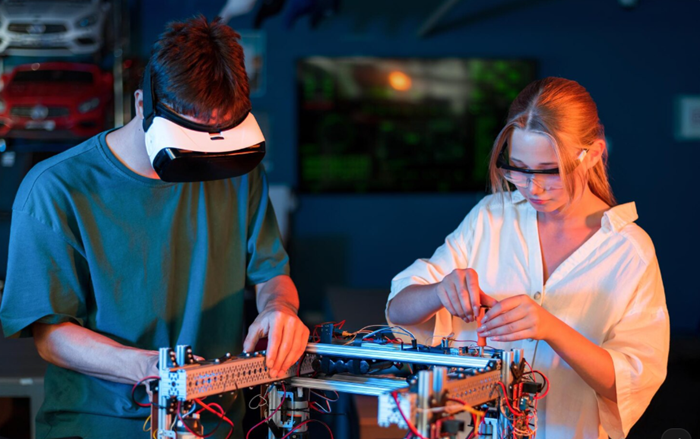
Artificial intelligence systems are increasingly being developed to interact with the physical world. Unlike software that processes information without directly controlling machinery, physical AI must operate through robots, sensors, actuators, and other connected devices. Research demonstrations can show impressive capabilities, including object manipulation, navigation, and adaptive task execution. However, demonstrating a capability under controlled conditions is different from operating reliably in an industrial environment. Moving from a proof of concept to production requires addressing engineering challenges that are not always visible during early development.
Why a Successful Demonstration Is Only the Beginning
A proof of concept is typically designed to establish whether a technical idea is feasible. Developers may test an AI model using a limited range of objects, environmental conditions, and operating scenarios. The objective is often to demonstrate that a particular task can be completed. Production systems, by contrast, must perform consistently over extended periods. They must also respond safely when conditions differ from those encountered during development.
This difference becomes clear in robotic manipulation. A robot may successfully pick and place an object during a laboratory demonstration. In a factory, the same task may involve thousands of repetitions, varying component positions, and gradual changes in equipment condition. Lighting may change, surfaces may become contaminated, and sensors may produce imperfect measurements. These factors can expose weaknesses that were not apparent during initial testing.
The Importance of Defining Operational Boundaries
Physical AI systems need clearly defined operating conditions. Engineers must establish which objects, environments, and task variations the system is expected to handle. These boundaries provide a basis for development and validation. Without them, it becomes difficult to determine whether a system is ready for production. A demonstration involving a narrow selection of objects does not establish reliable performance across an entire product range.
Operational boundaries should include both normal and foreseeable abnormal conditions. Examples include partially obscured objects, missing components, sensor errors, and unexpected equipment states. Developers need to determine how the system should respond when it cannot complete a task confidently. In some situations, retrying an operation may be appropriate. In others, stopping the equipment and requesting human intervention may be necessary.
The Gap Between Simulation and Reality
Simulation is widely used in robotics development because it allows engineers to test algorithms without repeatedly operating physical equipment. Virtual environments can reproduce robot geometry, movement constraints, and selected physical interactions. They can also generate large quantities of training data. This makes simulation valuable for developing perception and planning systems. However, simulated environments cannot perfectly represent every characteristic of the physical world.
Small differences can have important consequences. A simulated object may have idealized friction properties, while a real component may be covered in oil or dust. Camera images may differ because of reflections, lighting, or sensor noise. Mechanical components can also exhibit wear, vibration, and positioning errors. These discrepancies are often described as the simulation-to-reality gap.
Methods for Improving Real-World Reliability
Developers use several techniques to reduce the impact of differences between simulation and reality. Domain randomization introduces variations into simulated environments, such as changes in lighting, textures, and object positions. This can help models become less dependent on specific training conditions. Other approaches involve calibrating simulations using measurements from physical equipment. Real-world testing remains necessary to determine whether these methods provide sufficient reliability.
Testing should cover more than successful task completion. Engineers need to examine failure frequency, recovery behavior, and performance under changing conditions. A system that succeeds in most attempts may still be unsuitable for an application where failures create expensive downtime. The acceptable failure rate depends on the process and its consequences. Production readiness therefore requires application-specific performance criteria.
Integrating AI With Industrial Equipment
Physical AI systems must communicate with machines that have their own controllers, interfaces, and operating requirements. A robotic planning application may need information from cameras, programmable logic controllers, and machine-state sensors. It must then translate decisions into commands that the equipment can execute. Communication delays, inconsistent data formats, and synchronization errors can affect performance. These integration issues often require substantial engineering work.
The challenge is examined in discussions of Physical AI deployment, particularly the transition from experimental demonstrations to industrial operation. This transition involves more than improving the accuracy of an AI model. Developers must establish reliable communication, appropriate control interfaces, and predictable responses to system failures. They also need to ensure that the AI application operates within the mechanical and safety limits of the equipment. These requirements can determine whether a technically promising prototype becomes a usable production system.
Safety Engineering for AI-Controlled Physical Systems
Safety is one of the most significant differences between purely digital AI applications and systems that control physical equipment. An incorrect software decision may cause a robot to move unexpectedly or interact with an object in an unsafe manner. The consequences depend on the machinery, tooling, and surrounding environment. Industrial applications therefore require systematic hazard identification and risk assessment. AI capabilities must be incorporated into an appropriate safety architecture.
Safety-related control functions should not depend solely on the correctness of an AI model’s predictions. Protective systems may include safety-rated sensors, monitored stopping functions, interlocks, and other engineered safeguards. Their selection depends on the hazards and applicable standards. Engineers must also consider how changes in software behavior could affect previously validated operating conditions. An AI system that can select different task sequences may require additional analysis of foreseeable movements and interactions.
Why Uncertainty Must Be Managed
AI models can produce incorrect predictions even when they perform well during testing. A vision model might misidentify an object, while a planning system might select an action based on incomplete information. Physical AI applications therefore need mechanisms for recognizing uncertain or invalid conditions. These mechanisms may involve confidence thresholds, independent verification, or predefined operating limits. Their effectiveness must be evaluated rather than assumed.
Not every uncertainty can be expressed through a reliable numerical confidence score. Some models may produce confident predictions for unfamiliar inputs. Engineers should therefore combine model-level checks with process-level monitoring. For example, sensors can verify whether a component has actually been gripped or positioned correctly. Such feedback helps prevent a single incorrect prediction from affecting subsequent operations.
The Operational Challenges of Continuous Deployment
A laboratory prototype may operate for a limited period under direct engineering supervision. Industrial equipment must often function across multiple shifts with routine maintenance rather than constant developer attention. This creates requirements for monitoring, diagnostics, and recovery procedures. Operators need to understand when the system is functioning normally and when intervention is required. Maintenance teams also need sufficient information to investigate failures.
Software updates introduce another challenge. Changes to an AI model can affect behavior even when the surrounding hardware remains unchanged. A new version may improve performance for some objects while reducing reliability for others. Developers therefore need controlled testing and deployment procedures. Version management, rollback capabilities, and records of validation results are important elements of production operation.
Monitoring Performance After Installation
Physical AI performance can change over time. Cameras may become misaligned, lighting conditions may deteriorate, and mechanical equipment may experience wear. New product variants can introduce inputs that were not represented during initial development. Continuous monitoring helps identify these changes before they cause widespread operational problems. The appropriate indicators depend on the application.
Useful measurements may include task completion rate, cycle-time variation, perception errors, and operator interventions. Engineers should also record the circumstances surrounding unsuccessful operations. This information can help distinguish problems caused by the AI model from those caused by hardware or process conditions. Monitoring systems must provide actionable information rather than simply collecting large volumes of data. The objective is to support reliable operation and informed maintenance decisions.
Establishing Production Readiness Criteria
Moving physical AI into production requires measurable acceptance criteria. These should be defined before the final validation phase rather than selected after successful testing. Criteria may include task success rates, maximum cycle times, permitted operating conditions, and required responses to specific failures. Safety requirements must be evaluated separately from general performance targets. A system that meets productivity objectives but fails essential safety requirements is not ready for deployment.
Validation should include realistic production scenarios and sufficient operating time to expose recurring problems. Engineers may test different product variants, environmental conditions, and expected equipment states. They should also evaluate how the system behaves after interruptions and restarts. Documentation must describe the tested configuration and any remaining limitations. This creates a basis for deciding whether the system can be introduced into routine operation.
Scaling Physical AI Across Multiple Sites
A successful deployment at one facility does not guarantee that the same system will work without modification elsewhere. Factories may use different robot models, fixtures, machine interfaces, and production layouts. Environmental conditions and maintenance practices can also vary. These differences may require recalibration, software configuration, and additional validation. Scaling physical AI therefore involves both technical standardization and site-specific engineering.
Reusable software components can reduce repeated development effort. Standardized communication interfaces and clearly defined task models may also simplify integration. However, physical constraints such as robot reach, gripping forces, and workspace geometry remain specific to each installation. Deployment teams need procedures for identifying and documenting these differences. The ability to reproduce validated performance across sites is an important measure of industrial maturity.
Production scaling also changes the demands placed on support teams. A single prototype can often be maintained by the engineers who developed it. A network of deployed systems requires structured documentation, training, monitoring, and maintenance responsibilities. Software changes must be coordinated across installations with potentially different operating conditions. These organizational requirements become increasingly important as physical AI moves beyond isolated experimental applications.